Botanika
Tropical Tree Seeds Wholesale and Retails Seeds
Tropical Tree Seeds Wholesale and Retails Seeds
Impossible de charger la disponibilité du service de retrait
“Explore our Tropical Tree Seeds catalog below and order your favorite varieties today – shipped worldwide straight to your doorstep. If a species from the list is not currently available in our store, please contact us for availability – we may still have fresh stock ready for you.”
Contact Us Today
For bulk orders, wholesale pricing, or rare species not listed in our store, reach out to us directly:
We’ll be happy to confirm availability, share fresh stock updates, and assist with worldwide shipping.
1. Acacia abyssinica
Common Name: Abyssinian Acacia
A medium to large deciduous tree native to the Ethiopian highlands and East Africa. It provides shade, fodder, and nitrogen enrichment, and is often planted for soil conservation.
USDA Zone: 9–11
2. Acacia brevispica
Common Name: Prickly Acacia / Short-spined Acacia
A hardy, spiny shrub or small tree common in East African drylands. It is valued as browse for livestock and as a natural fence due to its dense thorns.
USDA Zone: 9–11
3. Acacia drepanolobium
Common Name: Whistling Thorn
A distinctive acacia with swollen thorns that often house protective ants. It thrives in savannas and supports unique ant–plant symbiosis.
USDA Zone: 9–11
4. Acacia elatior
Common Name: River Acacia
Tall and fast-growing, this tree is found along rivers and seasonal streams in dry savannas. It provides shade, timber, and erosion control.
USDA Zone: 9–11
5. Acacia gerrardii
Common Name: Gerrard’s Acacia
A small to medium-sized tree of African savannas, it tolerates drought and poor soils. Widely used for firewood and grazing.
USDA Zone: 9–11
6. Acacia horrida
Common Name: Cat Thorn / River Thorn
Known for its vicious hooked spines, this tree is native to southern and East Africa. It forms impenetrable thickets and is used as a living fence.
USDA Zone: 9–11
7. Acacia kirkii
Common Name: Water Acacia
A riverine tree found in floodplains and wetlands of East Africa. Its pods and foliage provide fodder, while the wood is used for poles and fuel.
USDA Zone: 10–11
8. Acacia lahai
Common Name: Mount Kenya Acacia
An East African highland acacia, adapted to dry montane forests and savannas. It provides valuable shade and browse.
USDA Zone: 9–11
9. Acacia mangium
Common Name: Mangium Wattle
Native to Australia and Papua New Guinea, this fast-growing plantation tree is used for timber, pulpwood, and reforestation.
USDA Zone: 10–12
10. Acacia mearnsii
Common Name: Black Wattle
Widely planted for tannin, firewood, and timber. Originally from Australia, it has become naturalized in parts of Africa and Asia.
USDA Zone: 9–11
11. Acacia melanoxylon
Common Name: Australian Blackwood
Native to southeastern Australia, this tall, fast-growing tree produces valuable timber and is also used in windbreaks and ornamental planting.
USDA Zone: 9–11
12. Acacia mellifera
Common Name: Black Thorn
A multi-stemmed shrub or small tree widespread in arid Africa. It forms dense thickets and is important for firewood, fencing, and forage.
USDA Zone: 9–11
13. Acacia nilotica
Common Name: Gum Arabic Tree / Egyptian Thorn
A thorny tree native to Africa and India, valued for gum arabic, fodder, and timber. Also used in traditional medicine.
USDA Zone: 9–11
14. Acacia nubica
Common Name: Nubian Acacia
A small tree or shrub adapted to hot, arid environments of Sudan and East Africa, providing browse and firewood.
USDA Zone: 10–11
15. Acacia polyacantha
Common Name: White Thorn
A tall tree with pale bark and long spines, found in savannas across Africa. Provides shade, gum, and medicinal bark.
USDA Zone: 9–11
16. Acacia reficiens
Common Name: Red Thorn
A thorny shrub of East African drylands, forming dense stands used for fencing, fuelwood, and browse.
USDA Zone: 9–11
17. Acacia senegal
Common Name: Gum Arabic Tree
Famous for producing high-quality gum arabic, this drought-tolerant tree is native to the Sahel and East Africa. It is also used for fodder and land rehabilitation.
USDA Zone: 9–11
18. Acacia seyal
Common Name: Red Acacia
A savanna tree with reddish bark, widespread in Africa. Produces gum talha and is valuable for fodder and fuel.
USDA Zone: 9–11
19. Acacia sieberiana
Common Name: Paperbark Thorn
A large, spreading tree with papery bark, common in African savannas. Provides shade, fodder, and soil improvement.
USDA Zone: 9–11
20. Acacia tortilis
Common Name: Umbrella Thorn Acacia
One of the most iconic African savanna trees, with a flat-topped crown. Extremely drought-tolerant and vital for fodder, firewood, and shade.
USDA Zone: 9–11
21. Acacia xanthophloea
Common Name: Fever Tree
A striking African tree with smooth, yellow-green bark. Common along rivers and wetlands, it is highly ornamental and important for wildlife.
USDA Zone: 9–11
22. Acacia zanzibarica
Common Name: Zanzibar Thorn
A spiny shrub or small tree native to coastal East Africa, adapted to dry, sandy soils. Often used for hedges, firewood, and browse.
USDA Zone: 10–11
23. Acokanthera schimperi
Common Name: Bushman’s Poison / Poison Arrow Tree
A shrub or small tree found in East African woodlands. Known for its toxic sap historically used for arrow poison, it also has medicinal applications in controlled doses.
USDA Zone: 9–11
24. Acrocarpus fraxinifolius
Common Name: Shingle Tree / Mundani
A fast-growing timber tree from South and Southeast Asia, introduced in Africa for reforestation and shade. Produces durable wood.
USDA Zone: 10–12
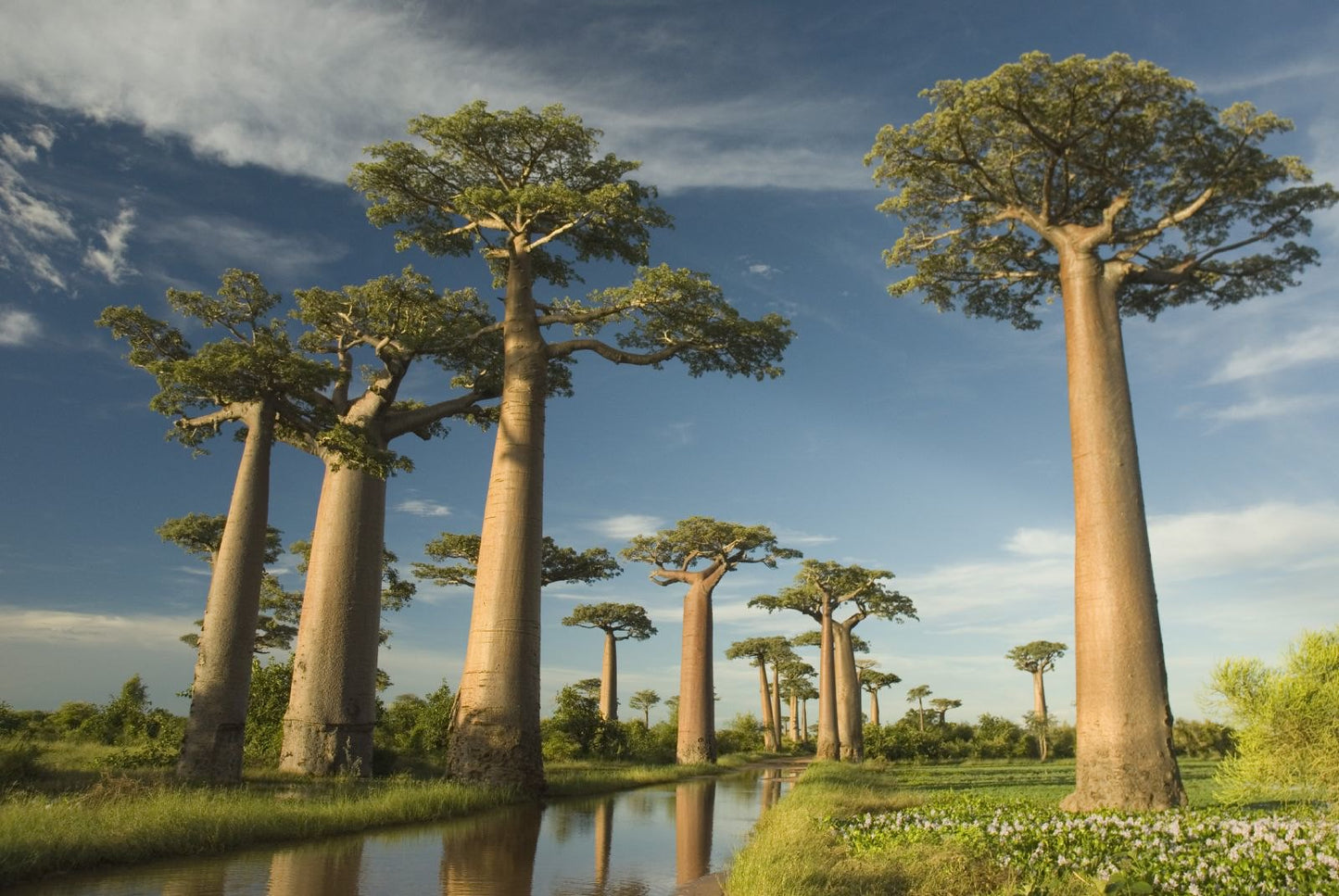
25. Adansonia digitata
Common Name: Baobab
An iconic African tree with a massive trunk and longevity. Its fruits (baobab powder) are highly nutritious, and the leaves, bark, and seeds have many traditional uses.
USDA Zone: 10–12
26. Adenanthera pavonina
Common Name: Red Sandalwood / Coral Wood
Native to Asia, this ornamental and multipurpose tree has bright red seeds often used as beads. The wood is durable and used in furniture.
USDA Zone: 10–12
27. Afzelia quanzensis
Common Name: Pod Mahogany / Mkora
A valuable timber tree of southern and East Africa. Produces attractive hardwood used in flooring and carpentry.
USDA Zone: 10–12
28. Albizia coriaria
Common Name: Brown Olive / Mugavu
Native to East Africa, this tree is used for timber, shade, and traditional medicine. Its bark extracts are used in tanning and herbal remedies.
USDA Zone: 10–11
29. Albizia grandibracteata
Common Name: Large-bracted Albizia
A tall African tree found in moist forests and river valleys. Known for its broad canopy and soil-enriching properties.
USDA Zone: 9–11
30. Albizia gummifera
Common Name: Smooth-barked Albizia
A large, spreading tree common in African montane and riverine forests. Provides shade, fodder, and improves soil fertility.
USDA Zone: 9–11
31. Albizia lebbeck
Common Name: Woman’s Tongue Tree / Siris Tree
A fast-growing shade tree native to South Asia, widely planted in Africa. It improves soil fertility and provides timber, fodder, and shade.
USDA Zone: 9–11
32. Albizia lophantha → (correct name: Paraserianthes lophantha)
Common Name: Crested Wattle / Cape Leeuwin Wattle
Native to southwestern Australia, this quick-growing tree is used for soil stabilization, fodder, and ornamental planting.
USDA Zone: 9–11
33. Albizia procera
Common Name: White Siris
A large deciduous tree native to South and Southeast Asia. Grown for timber, shade, and reforestation projects in tropical regions.
USDA Zone: 10–12
34. Allophylus abyssinicus
Common Name: African False Currant
A small tree native to East Africa, found in forests and wooded grasslands. Its fruits are edible and it is valued as a medicinal plant.
USDA Zone: 9–11
35. Araucaria angustifolia
Common Name: Paraná Pine / Brazilian Pine
Native to southern Brazil, this evergreen conifer is prized for timber and edible seeds (pine nuts). Also planted as an ornamental.
USDA Zone: 9–11
36. Araucaria cunninghamii
Common Name: Hoop Pine
A tall conifer native to Australia and New Guinea, used extensively for timber and also grown ornamentally in tropical regions.
USDA Zone: 10–12
37. Atriplex nummularia (corrected spelling)
Common Name: Old Man Saltbush
A hardy, salt-tolerant shrub native to Australia. Widely planted as livestock fodder and for soil reclamation in arid areas.
USDA Zone: 8–11
38. Azanza garckeana
Common Name: Snot Apple / Mutohwe
A fruit-bearing tree native to southern and East Africa. Its edible fruits are sticky when chewed and are rich in nutrients.
USDA Zone: 10–12
39. Balanites aegyptiaca
Common Name: Desert Date
A resilient desert tree native to Africa and the Middle East. Produces edible fruits, medicinal extracts, and oil-rich seeds.
USDA Zone: 10–12
40. Balanites orbicularis
Common Name: Round-leaved Desert Date
A relative of the Desert Date, this species is native to East Africa’s drylands. Used for fodder, shade, and traditional medicine.
USDA Zone: 10–11
41. Balanites wilsoniana
Common Name: Giant Desert Date
A large African tree producing edible but bitter fruits. Its wood is durable, and it is valued for shade and traditional medicine.
USDA Zone: 10–12
42. Berchemia discolor
Common Name: Bird Plum
A semi-deciduous African tree bearing sweet, edible fruits eaten fresh or dried. Widely used in agroforestry and for shade.
USDA Zone: 9–11
43. Bischofia javanica
Common Name: Bishop Wood
Native to Asia and the Pacific, this tall tree produces durable timber and has traditional medicinal uses. Often planted as a shade and ornamental tree.
USDA Zone: 10–12
44. Brachychiton acerifolius
Common Name: Illawarra Flame Tree
A spectacular Australian tree with bright red flowers. Popular as an ornamental tree, it also produces lightweight timber.
USDA Zone: 10–12
45. Brachylaena huillensis
Common Name: Muhugu
Native to East Africa, this hardwood tree is prized for furniture making and carving. Found in montane and coastal forests.
USDA Zone: 9–11
46. Brachystegia spiciformis (correct spelling)
Common Name: Miombo
A dominant species of the Miombo woodlands in central and southern Africa. Provides firewood, honey resources, and shade.
USDA Zone: 9–11
47. Caesalpinia volkensii
Common Name: Volkens’ Caesalpinia
A spiny shrub or small tree native to East Africa. Used as a living fence and for ornamental purposes.
USDA Zone: 9–11
48. Calliandra calothyrsus
Common Name: Calliandra / Powderpuff Tree
A fast-growing nitrogen-fixing shrub from Central America, widely planted for fodder, fuelwood, and erosion control.
USDA Zone: 9–11
49. Callistemon citrinus
Common Name: Crimson Bottlebrush
An Australian ornamental shrub with bright red, brush-like flowers. Widely planted in gardens and used as a hedge.
USDA Zone: 9–11
50. Callistemon lanceolatus (synonym of Callistemon citrinus, often considered the same species)
Common Name: Lance-leaved Bottlebrush
An ornamental shrub with crimson flowers, drought-tolerant and attractive to pollinators.
USDA Zone: 9–11
51. Callistemon viminalis
Common Name: Weeping Bottlebrush
An ornamental tree from Australia with drooping branches and bright red flower spikes. Popular for landscaping and as a pollinator plant.
USDA Zone: 9–11
52. Callitris robusta (often treated as Callitris columellaris)
Common Name: White Cypress Pine
A hardy Australian conifer valued for durable termite-resistant timber and windbreak planting.
USDA Zone: 9–11
53. Calodendrum capense
Common Name: Cape Chestnut
An attractive ornamental tree native to southern Africa, with large clusters of pink flowers. Also provides oil-rich seeds used in cosmetics.
USDA Zone: 10–12
54. Casearia battiscombei (correct spelling of “battiscombe”)
Common Name: Battiscombe’s Casearia
A forest tree from East Africa, used locally for timber and shade. Rarely cultivated but important in indigenous woodland ecosystems.
USDA Zone: 10–11
55. Casuarina junghuhniana (correct spelling of “jughuniana”)
Common Name: Mountain She-oak
A tall, fast-growing Australian tree introduced widely in Africa for timber, fuelwood, and soil conservation.
USDA Zone: 9–11
56. Celtis africana
Common Name: White Stinkwood
A widespread African tree used for shade, fodder, and light timber. Popular in landscaping due to its graceful crown.
USDA Zone: 9–11
57. Chorisia speciosa (now classified as Ceiba speciosa)
Common Name: Silk Floss Tree
A South American ornamental tree with large pink flowers and a spiny trunk. Grown in parks and gardens for its beauty.
USDA Zone: 10–12
58. Chorisia ventricosa (likely a synonym of Ceiba speciosa, often confused in trade)
Common Name: Spiny Silk Floss Tree
Closely related to Ceiba speciosa, with ornamental spiny trunks and showy flowers.
USDA Zone: 10–12
59. Combretum schumannii
Common Name: Schumann’s Combretum
A large African tree producing hardwood used in construction and firewood. Found in savanna woodlands.
USDA Zone: 9–11
60. Combretum zeyheri
Common Name: Large-fruited Bushwillow
An African savanna tree with distinctive winged fruits. Provides firewood, shade, and traditional medicinal uses.
USDA Zone: 9–11
61. Commiphora baluensis
Common Name: Balu Commiphora
A drought-tolerant shrub or small tree from East Africa, belonging to the myrrh family. Known for its resin and use in traditional medicine.
USDA Zone: 10–12
62. Conocarpus lancifolius (correct spelling)
Common Name: Damas Tree
Native to coastal East Africa and Arabia, this fast-growing tree is used for shade, windbreaks, and urban landscaping.
USDA Zone: 10–12
63. Cordeauxia edulis
Common Name: Yeheb Nut
A rare shrub native to Somalia and Ethiopia, producing edible seeds considered a delicacy. Drought-resistant and culturally important.
USDA Zone: 10–12
64. Cordia africana
Common Name: Sudan Teak
A widespread African tree valued for quality timber, shade, and fodder. Its fast growth makes it useful in agroforestry systems.
USDA Zone: 9–11
65. Cordia monoica
Common Name: Indian Cordia
A hardy shrub or small tree from dry regions of Africa and Asia, used for fodder, firewood, and traditional medicine.
USDA Zone: 10–12
66. Cordia sinensis
Common Name: Grey-leaved Cordia
Native to arid East Africa, this small tree provides fodder, fuel, and edible fruits. Often planted in agro-pastoral systems.
USDA Zone: 10–12
67. Craibia brownii
Common Name: Brown’s Craibia
A tall forest tree of East Africa, known for its large leaves and timber value. Also contributes to forest canopy diversity.
USDA Zone: 9–11
68. Croton macrostachyus
Common Name: Broad-leaved Croton
A fast-growing African tree with medicinal bark and seeds. Used in reforestation, shade, and traditional medicine.
USDA Zone: 9–11
69. Croton megalocarpus
Common Name: Croton Tree
Native to East Africa, widely planted for biodiesel production, shade, and soil fertility improvement.
USDA Zone: 9–11
70. Cryptomeria japonica
Common Name: Japanese Cedar / Sugi
A tall evergreen conifer native to Japan. Grown worldwide for timber, reforestation, and as an ornamental.
USDA Zone: 7–10
81. Diospyros scabra
Common Name: Rough-leaved Ebony
A shrub or small tree native to dry regions of Africa. Produces hard wood and is used locally for tool handles and firewood.
USDA Zone: 9–11
82. Dobera glabra
Common Name: Desert Date Dobera
A hardy evergreen tree of arid East Africa. Its leaves and fruits provide famine food and fodder.
USDA Zone: 10–12
83. Dodonaea viscosa (correct spelling of “Dodonea”)
Common Name: Sand Olive / Hopbush
A tough shrub found worldwide in tropical and subtropical regions. Grown for erosion control, windbreaks, and ornamentals.
USDA Zone: 9–11
84. Dombeya torrida
Common Name: East African Dombeya
A small tree native to African highlands. Produces clusters of attractive flowers and is used in reforestation and ornamental planting.
USDA Zone: 9–11
85. Dovyalis abyssinica
Common Name: Abyssinian Dovyalis
A spiny African shrub producing edible, acidic fruits. Used for hedges, jams, and fodder.
USDA Zone: 9–11
86. Dovyalis caffra
Common Name: Kei Apple
A hardy shrub or small tree native to southern Africa. Fruits are edible and made into jams; also used for dense hedges.
USDA Zone: 9–11
87. Drypetes gerrardii
Common Name: Gerrard’s Ironwood
A forest tree of East and southern Africa, producing hard, durable wood. Also valued in traditional medicine.
USDA Zone: 9–11
88. Ehretia cymosa
Common Name: Puzzle Bush / Ehretia
A small African tree with edible orange fruits and medicinal uses. Found in savanna and woodland areas.
USDA Zone: 9–11
89. Entada abyssinica
Common Name: St. Thomas Bean / Entada
A large African liana or small tree. Known for its large pods and traditional medicinal applications.
USDA Zone: 10–12
90. Erythrina abyssinica
Common Name: Red Hot Poker Tree
A striking African tree with bright red flowers. Used as a shade and ornamental tree, and also in traditional medicine.
USDA Zone: 9–11
91. Erythrina burttii
Common Name: Burtt’s Coral Tree
A flowering tree native to East Africa. Known for its red blossoms and use as a shade tree in farms and homesteads.
USDA Zone: 9–11
92. Erythrophleum guineense (correct spelling of “guineese”)
Common Name: Ordeal Tree
A tall African tree producing extremely hard wood. Historically used in traditional rituals, and its bark contains powerful alkaloids.
USDA Zone: 10–12
93. Eucalyptus camaldulensis (extra parenthesis removed)
Common Name: River Red Gum
A hardy Australian tree widely planted in Africa for fuelwood, timber, and erosion control. Extremely drought-tolerant.
USDA Zone: 8–11
94. Eucalyptus ficifolia (now Corymbia ficifolia)
Common Name: Red Flowering Gum
A spectacular ornamental tree from Australia with clusters of red to orange blossoms. Grown in gardens and along streets.
USDA Zone: 9–11
95. Eucalyptus globulus
Common Name: Blue Gum
One of the most widely planted eucalyptus species. Valued for fast-growing timber, pulpwood, and windbreaks.
USDA Zone: 9–11
96. Eucalyptus grandis
Common Name: Rose Gum / Flooded Gum
A tall, fast-growing plantation species from Australia. Important for timber, poles, and pulpwood.
USDA Zone: 9–11
97. Eucalyptus maculata (now Corymbia maculata)
Common Name: Spotted Gum
A durable timber tree from Australia, with distinctive spotted bark. Used in construction and ornamental planting.
USDA Zone: 9–11
98. Eucalyptus paniculata (now Corymbia maculata var., but often listed separately)
Common Name: Grey Ironbark
An Australian tree producing extremely strong, durable timber, resistant to decay and termites.
USDA Zone: 9–11
99. Eucalyptus regnans
Common Name: Mountain Ash
The tallest flowering plant in the world, native to southeastern Australia. Cultivated in plantations for timber and pulp.
USDA Zone: 9–11
100. Eucalyptus saligna
Common Name: Sydney Blue Gum
A tall, straight tree native to Australia. Grown extensively in plantations for timber, poles, and reforestation.
USDA Zone: 9–11
101. Eucalyptus urophylla
Common Name: Timor Mountain Gum
Native to islands of Indonesia and Timor, this fast-growing tree is widely planted for pulpwood, timber, and reforestation.
USDA Zone: 9–11
102. Faidherbia albida (correct spelling; originally “Faidhebia”)
Common Name: Apple-ring Acacia
A unique African tree that sheds leaves during the rainy season, making it excellent for agroforestry. Its pods are highly nutritious livestock fodder.
USDA Zone: 9–11
103. Faurea saligna
Common Name: Beechwood
An African tree with attractive foliage and small flowers. Grown for shade, ornamental use, and light timber.
USDA Zone: 9–11
104. Flacourtia indica
Common Name: Governor’s Plum
A hardy shrub or small tree native to Africa and Asia, producing edible plum-like fruits. Used for hedges, shade, and traditional medicine.
USDA Zone: 9–11
105. Fraxinus pennsylvanica
Common Name: Green Ash
Native to North America, this fast-growing shade tree is widely planted in urban landscapes and for windbreaks.
USDA Zone: 3–9
106. Gardenia volkensii
Common Name: Bushveld Gardenia
A small, fragrant-flowered shrub or tree from Africa. The strongly scented white flowers and edible fruits make it highly valued.
USDA Zone: 9–11
107. Gmelina arborea
Common Name: Gmelina / White Teak
A fast-growing tropical tree native to Asia, widely planted for timber, furniture, and reforestation in Africa.
USDA Zone: 10–12
108. Grevillea robusta
Common Name: Silky Oak
A tall Australian tree, popular in agroforestry for shade, windbreaks, and quality timber. Also widely used as an ornamental.
USDA Zone: 9–11
109. Grewia discolor
Common Name: Donkey Berry
A shrub or small tree native to Africa, producing sweet, edible berries. Provides fodder, shade, and traditional remedies.
USDA Zone: 9–11
110. Grewia villosa
Common Name: Hairy-leaved Grewia
An African shrub producing edible fruits often used in juices and traditional drinks. Hardy and drought-tolerant.
USDA Zone: 9–11
111. Gliricidia sepium
Common Name: Gliricidia / Quickstick
A fast-growing nitrogen-fixing tree from Central America, widely used in Africa for fodder, fuelwood, live fencing, and soil improvement.
USDA Zone: 9–11
112. Gyrocarpus americanus
Common Name: Helicopter Tree / Shiral
A tropical tree with distinctive winged fruits that spin like propellers. Found in Asia, Africa, and the Pacific islands.
USDA Zone: 10–12
113. Hagenia abyssinica
Common Name: African Redwood
A highland African tree with medicinal flowers traditionally used as a remedy for tapeworm. Also valued for shade and timber.
USDA Zone: 9–11
114. Hakea saligna
Common Name: Willow-leaved Hakea
An evergreen shrub or small tree from Australia, cultivated for hedges and ornamental use. Drought-tolerant and hardy.
USDA Zone: 9–11
115. Harungana madagascariensis
Common Name: Orange-milk Tree
A tropical African tree with orange sap, used in traditional medicine. Also valuable for reforestation and fuelwood.
USDA Zone: 10–12
116. Hymenaea verrucosa
Common Name: East African Copal Tree
Produces resin known as copal, historically used in varnishes and incense. Found in coastal East Africa.
USDA Zone: 10–12
117. Hyphaene compressa
Common Name: East African Doum Palm
A palm with clustered trunks, producing edible fruits. Used for weaving, construction, and food in arid areas.
USDA Zone: 10–12
118. Hyphaene coriacea
Common Name: Ilala Palm
Native to southern Africa, valued for its edible fruit, palm wine, and weaving materials.
USDA Zone: 10–12
119. Jacaranda mimosifolia (correct spelling of “mimiosifolia”)
Common Name: Jacaranda
A famous ornamental tree from South America, with stunning lavender-blue flowers. Widely planted in tropical and subtropical cities.
USDA Zone: 9–11
120. Jatropha curcas
Common Name: Physic Nut
A hardy shrub native to Central America, now grown worldwide for biofuel production. Also used for fencing and erosion control.
USDA Zone: 9–11
121. Juniperus procera
Common Name: African Pencil Cedar
A tall conifer native to East African highlands. Valued for durable timber, incense, and as a forest tree in montane regions.
USDA Zone: 8–11
122. Khaya anthotheca
Common Name: East African Mahogany
A large forest tree producing high-quality mahogany timber. Widely valued for furniture, construction, and carving.
USDA Zone: 10–12
123. Kigelia africana
Common Name: Sausage Tree
An African savanna tree with large sausage-shaped fruits. Grown ornamentally and used in traditional medicine.
USDA Zone: 10–12
124. Lannea elata
Common Name: Lannea
A deciduous African tree used for timber, fodder, and traditional remedies. Its fruits are edible and enjoyed locally.
USDA Zone: 9–11
125. Lawsonia inermis
Common Name: Henna
A shrub or small tree native to North Africa and Asia. Famous for producing henna dye from its leaves.
USDA Zone: 9–11
126. Leucaena diversifolia
Common Name: Leucaena
A nitrogen-fixing tree native to Central America. Used for fodder, green manure, and erosion control.
USDA Zone: 9–11
127. Leucaena leucocephala
Common Name: White Leadtree
A widely planted multipurpose species for fodder, firewood, and soil enrichment. Fast-growing but can become invasive.
USDA Zone: 9–11
128. Leucaena pallida
Common Name: Pale Leucaena
A shrubby nitrogen-fixing tree used in fodder and agroforestry systems. Hardy in dry areas.
USDA Zone: 9–11
129. Leucaena trichandra
Common Name: Hairy Leucaena
A drought-tolerant, nitrogen-fixing tree from Central America. Used in fodder systems and soil conservation.
USDA Zone: 9–11
130. Maesopsis eminii
Common Name: Musizi
A fast-growing African forest tree widely used in agroforestry and plantations for timber, poles, and reforestation.
USDA Zone: 10–12
131. Markhamia lutea
Common Name: Nile Tulip Tree
A fast-growing East African tree with bright yellow, trumpet-shaped flowers. Popular for ornamental planting, shade, and timber.
USDA Zone: 9–11
132. Melia azedarach
Common Name: Persian Lilac / Chinaberry Tree
A medium-sized tree native to Asia, often planted as an ornamental and shade tree. Produces small lilac flowers and bead-like fruits.
USDA Zone: 9–11
133. Melia volkensii
Common Name: Mukau
An important timber tree native to Kenya’s drylands. Produces high-quality hardwood resistant to termites and drought.
USDA Zone: 9–11
134. Melia volkensii (Nuts)
Common Name: Mukau (Seed Source)
Same as above, listed here specifically for its seeds, which are propagated for dryland forestry.
USDA Zone: 9–11
135. Milicia excelsa
Common Name: Iroko
A massive African tree producing durable hardwood often called "African teak." Used for construction, furniture, and shipbuilding.
USDA Zone: 10–12
136. Millettia dura (correct spelling of “Milletia”)
Common Name: Dura Millettia
A leguminous African tree used for shade, fodder, and traditional medicine. Found in savanna and forest edges.
USDA Zone: 9–11
137. Mimusops kummel
Common Name: Kummel / Wild Medlar
An evergreen forest tree of East Africa. Produces edible fruits and durable timber.
USDA Zone: 10–12
138. Moringa oleifera
Common Name: Drumstick Tree / Horseradish Tree
A fast-growing tree native to South Asia, now cultivated worldwide. Leaves, pods, and seeds are highly nutritious and medicinal.
USDA Zone: 9–11
139. Moringa stenopetala
Common Name: African Moringa / Cabbage Tree
Native to Ethiopia and Kenya, valued for its edible leaves and drought resistance. Used in food, medicine, and water purification.
USDA Zone: 9–11
140. Myrianthus holstii
Common Name: Giant Yellow Mulberry
A tropical African tree with edible fruits and leaves sometimes used as vegetables. Also valued in traditional medicine.
USDA Zone: 10–12
141. Mystroxylon aethiopicum
Common Name: Kooboo Berry
A small African tree or shrub producing edible red fruits. Also used for traditional medicine and hedges.
USDA Zone: 9–11
142. Newtonia buchananii
Common Name: Forest Newtonia
A tall African forest tree with spreading crown. Valued for shade, soil improvement, and timber.
USDA Zone: 10–12
143. Newtonia hildebrandtii
Common Name: Hildebrandt’s Newtonia
A large East African tree of coastal forests and river valleys. Provides timber and shade.
USDA Zone: 10–12
144. Newtonia paucijuga
Common Name: Paucijuga Newtonia
A semi-deciduous African tree of coastal woodlands, valued for heavy hardwood timber.
USDA Zone: 10–12
145. Ocotea usambarensis
Common Name: East African Camphorwood
A large evergreen tree native to East African montane forests. Produces aromatic timber used in furniture and construction.
USDA Zone: 9–11
146. Olea capensis subsp. hochstetteri
Common Name: East African Olive
A subspecies of African olive found in montane forests. Produces dense, hard timber and edible but small fruits.
USDA Zone: 9–11
147. Olea capensis subsp. welwitschii (correct spelling, not “welwitchii”)
Common Name: Welwitsch’s Olive
A subspecies of Cape Olive in African forests. Used for durable timber and traditional medicine.
USDA Zone: 9–11
148. Olea europaea subsp. africana
Common Name: Wild Olive
Native to Africa, this tree is related to the cultivated olive. Produces small edible fruits and extremely hard timber.
USDA Zone: 9–11
149. Paramacrolobium coeruleum
Common Name: Blue Macrolobium
A large African forest tree valued for shade and ornamental use. Produces hardwood used locally.
USDA Zone: 10–12
150. Parkinsonia aculeata
Common Name: Jerusalem Thorn / Horse Bean
A hardy thorny shrub or small tree native to the Americas, now grown in Africa for ornamentals, fodder, and live fencing.
USDA Zone: 9–11
151. Phoenix reclinata
Common Name: Wild Date Palm / Senegal Date Palm
A clumping palm native to Africa. Produces edible dates and is widely used for landscaping, weaving, and shade.
USDA Zone: 9–11
152. Piliostigma thonningii
Common Name: Camel’s Foot Tree
A common African savanna tree with camel-foot-shaped leaves. Provides fodder, shade, and traditional medicine.
USDA Zone: 9–11
153. Pinus caribaea
Common Name: Caribbean Pine
Native to Central America and the Caribbean. Grown in plantations for timber, resin, and pulpwood.
USDA Zone: 9–11
154. Pinus patula
Common Name: Mexican Weeping Pine
A high-altitude pine from Mexico, widely planted in Africa for timber, pulpwood, and windbreaks.
USDA Zone: 8–10
155. Pinus radiata
Common Name: Monterey Pine
Native to California, but the most widely planted commercial pine in the world. Provides high-quality timber and pulpwood.
USDA Zone: 8–10
156. Pithecellobium dulce
Common Name: Manila Tamarind
A thorny tree native to tropical America. Produces sweet edible pods and is used for shade, fodder, and living fences.
USDA Zone: 9–11
157. Podocarpus falcatus (now Afrocarpus falcatus)
Common Name: Outeniqua Yellowwood
A large African conifer used for timber, shade, and reforestation. Produces fleshy fruits eaten by birds.
USDA Zone: 9–11
158. Polyscias fulva
Common Name: Mushugi / African Aralia
A tall, fast-growing tree native to African montane forests. Used for reforestation, shade, and light timber.
USDA Zone: 9–11
159. Polyscias kikuyuensis
Common Name: Kikuyu Polyscias
An East African forest tree used for timber, shade, and as an ornamental in highland regions.
USDA Zone: 9–11
160. Premna maxima
Common Name: Premna
A small tree native to East Africa, valued for its medicinal uses and fodder. Grown in dry savanna woodlands.
USDA Zone: 10–12
161. Pyracantha angustifolia
Common Name: Narrow-leaved Firethorn
A thorny shrub from China, often grown as an ornamental hedge with clusters of bright red berries. Attracts birds and pollinators.
USDA Zone: 7–9
162. Schinus molle
Common Name: Peruvian Pepper Tree / False Pepper
An evergreen tree from South America, producing clusters of pink peppercorn-like berries. Used ornamentally and for shade.
USDA Zone: 8–11
163. Sclerocarya birrea
Common Name: Marula Tree
An iconic African savanna tree producing edible fruits used for beverages and oils. Also important in traditional medicine.
USDA Zone: 10–12
164. Senna siamea
Common Name: Siamese Cassia
A fast-growing Asian tree widely planted in Africa for timber, fodder, and shade. Its yellow flowers add ornamental value.
USDA Zone: 9–11
165. Senna spectabilis
Common Name: Spectacular Cassia
A tropical tree with golden-yellow flower clusters. Used as an ornamental, shade tree, and in agroforestry.
USDA Zone: 9–11
166. Sesbania grandiflora
Common Name: Agati / Vegetable Hummingbird
A fast-growing tree native to Southeast Asia, producing edible flowers and leaves. Commonly planted for fodder and soil improvement.
USDA Zone: 10–12
167. Sesbania sesban
Common Name: River Bean / Sesban
A small, fast-growing nitrogen-fixing tree. Extensively used in agroforestry for fodder, fuelwood, and green manure.
USDA Zone: 9–11
168. Spathodea campanulata
Common Name: African Tulip Tree
A striking ornamental with large scarlet-orange flowers. Widely planted in tropical regions for shade and beauty.
USDA Zone: 10–12
169. Strychnos henningsii
Common Name: Poison Strychnos
An evergreen African forest tree used in traditional medicine. Related to the source of strychnine but with varied local uses.
USDA Zone: 9–11
170. Syncarpia laurifolia (likely intended as Syncarpia glomulifera)
Common Name: Turpentine Tree
A tall Australian tree producing strong, durable timber and aromatic oils. Often planted for shade and windbreaks.
USDA Zone: 9–11
171. Tamarindus indica
Common Name: Tamarind
A tropical fruit tree native to Africa, now grown worldwide. Produces tangy pods used in food, drinks, and medicine.
USDA Zone: 10–12
172. Teclea nobilis (now Vepris nobilis)
Common Name: Teclea
An evergreen African tree found in forests and woodlands. Known for its fragrant leaves and use in traditional medicine.
USDA Zone: 9–11
173. Tecoma stans
Common Name: Yellow Bells / Trumpet Bush
A hardy ornamental shrub or small tree with clusters of yellow trumpet-shaped flowers. Drought-tolerant and widely grown in gardens.
USDA Zone: 9–11
174. Tectona grandis
Common Name: Teak ⭐
One of the world’s most valuable timber trees, native to Asia. Extensively planted in Africa for its durable hardwood.
USDA Zone: 10–12
175. Terminalia mentalis (likely a mislabel; possibly Terminalia mantaly – Madagascar Almond)
Common Name: Madagascar Almond
A popular ornamental tree with layered, umbrella-like branches. Used for landscaping and shade in tropical regions.
USDA Zone: 10–12
176. Terminalia brownii (Extracted)
Common Name: Brown Terminalia
An East African savanna tree providing medicinal bark extracts. Also used for timber and fuelwood.
USDA Zone: 9–11
177. Terminalia brownii (Fruits)
Common Name: Brown Terminalia
Same species as above, listed here specifically for its edible and medicinal fruits.
USDA Zone: 9–11
178. Terminalia prunoides
Common Name: Purplepod Terminalia
A shrub or small tree native to southern Africa. Used as a hedge and in traditional remedies.
USDA Zone: 9–11
179. Terminalia spinosa
Common Name: Spiny Terminalia
A drought-resistant African tree, important for firewood, poles, and traditional medicine.
USDA Zone: 9–11
180. Thevetia peruviana
Common Name: Yellow Oleander / Lucky Nut
An ornamental shrub with bright yellow flowers. Toxic if ingested, but widely planted for beauty and hedging.
USDA Zone: 9–11
181. Tipuana tipu
Common Name: Tipu Tree / Rosewood of the Andes
A fast-growing ornamental tree from South America. Produces yellow flowers and is widely planted for shade and avenue landscaping.
USDA Zone: 9–11
182. Tristania conferta (now Lophostemon confertus)
Common Name: Brisbane Box
An evergreen Australian tree with glossy leaves and cream-colored flowers. Used in urban landscaping for its resilience.
USDA Zone: 9–11
183. Vangueria madagascariensis
Common Name: Spanish Tamarind / Tamarind of Madagascar
A fruit-bearing African tree producing sweet, edible fruits used in drinks and jams.
USDA Zone: 10–12
184. Vitex keniensis
Common Name: Meru Oak ⭐
An endangered East African tree, producing highly valuable timber. Native to Kenya’s highlands and protected due to overharvesting.
USDA Zone: 9–11
185. Vitex payos
Common Name: Chocolate Berry
A small African tree producing edible brown fruits with a sweet flavor. Also valued for shade and traditional medicine.
USDA Zone: 9–11
186. Ximenia americana
Common Name: Sour Plum
A spiny shrub or small tree widespread in Africa. Fruits are edible and rich in oils; also used in traditional remedies.
USDA Zone: 9–11
187. Zanthoxylum gilletii (synonym: Fagara macrophylla)
Common Name: African Satinwood / Knobwood
A tall African forest tree valued for durable timber and medicinal bark.
USDA Zone: 10–12
188. Ziziphus abyssinica
Common Name: Abyssinian Jujube
A spiny shrub native to East Africa. Produces small edible fruits and is useful for fencing and erosion control.
USDA Zone: 9–11
189. Ziziphus mauritiana
Common Name: Indian Jujube / Ber
A fruit tree widely cultivated in Africa and Asia. Produces sweet edible fruits and tolerates drought well.
USDA Zone: 9–11
190. Ziziphus mucronata
Common Name: Buffalo Thorn
A common African savanna tree with zig-zag thorns. Provides edible fruits, fodder, and firewood.
USDA Zone: 9–11
Share